
The meeting after the decision
Imagine being invited to discuss the future of a local service after the budget, the brief and the preferred delivery model have already been settled. The meeting may be courteous. The presentation may be clear. The facilitators may sincerely want to listen. Yet the central question for a participant is still unresolved: what, precisely, remains open to influence? The experience of participation depends on the answer.
This illustrative situation captures a difficulty that reaches well beyond community consultation. Institutions can create many opportunities for expression while leaving their actual decisions difficult to reach. A person can be surveyed, counted and thanked without gaining a meaningful relationship to the institution’s choices. Over time, the gap between the language of engagement and the location of authority becomes something people learn to recognise.
Listen to what the numbers can and cannot say
In the OECD’s 2024 trust report, based on surveys conducted in 2023 across 30 member countries, 69% of respondents who felt they had a say in government reported high or moderately high trust in national government. Among those who felt they did not have a say, the corresponding share was 22%. These are associations between self-reported perceptions; they do not demonstrate that a particular participation exercise caused trust to rise.1
The result nevertheless identifies a relationship that institutional leaders should take seriously. Feeling able to influence government and trusting government are closely connected in that survey. A strategy for trust that concentrates entirely on communication may therefore be looking in too narrow a place. The question concerns the relationship between people and power as well as the clarity of an institution’s explanations.
View the underlying data
| Category | % of respondents |
|---|---|
| 2021 | 38 |
| 2023 | 46 |
| 2025 | 51 |
Decline is not the only available story
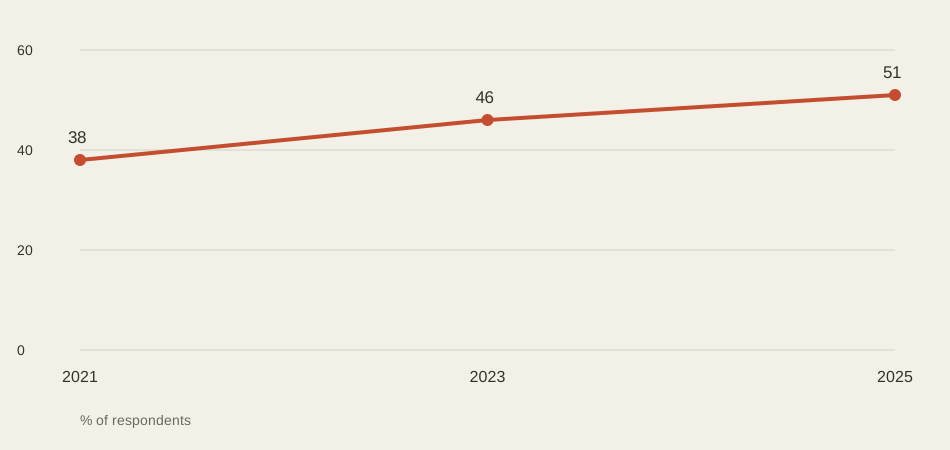
Trust should not be treated as a single, permanently falling national mood. The OECD’s 2026 country note reports that Australians expressing high or moderately high trust in federal government rose from 38% in 2021 to 46% in 2023 and 51% in 2025. The 2025 figure was above the OECD average of 40%. In these results, high or moderately high trust means responses of 6–10 on a 0–10 scale.2
These figures are useful precisely because they interrupt an easy story of inevitable decline. Institutions differ; countries differ; periods differ. Even within a country, a person’s confidence in the police, civil service, courts and elected government may be quite different. The practical response is to investigate which experiences and decisions matter in a particular setting. Pessimism can become its own excuse for avoiding that work.
Begin with an honest promise
The OECD’s participation guidelines begin with a defined purpose, an identifiable public problem and a clear account of how participation connects to a decision.3 These conditions sound modest. In practice they require an institution to do substantial internal work before it invites anyone into a room. Someone must decide what is negotiable, who has authority, what resources are available and how the contribution will enter the formal process.
A bounded promise can be more respectful than an expansive one. A council may be able to invite residents to choose between feasible uses of a limited budget while being unable to change the statutory obligations attached to the service. A community organisation may seek advice about access and programming while reserving employment decisions to its board. Clear limits allow people to decide whether and how to participate. Unstated limits invite misunderstanding.
The cost of having a voice
Participation asks people to contribute time, attention and often personal experience. Those costs are distributed unevenly. An evening meeting is straightforward for someone with a predictable timetable and nearby transport. It may be difficult for a person who works irregular shifts, provides care, needs an interpreter or cannot comfortably enter the venue. A digital survey removes some barriers while introducing others.
An institution that wants a broader conversation needs to design the conditions of participation. This may involve different formats, accessible information, suitable timing and support that makes attendance practical. The point is not to guarantee that every person will engage. It is to examine whether the institution has mistaken the convenience of its own process for the availability of the people whose knowledge it needs.
Keep a visible thread between input and action
A useful participation process leaves a trail that people can follow. It records what was heard, how competing concerns were considered, what changed and which requests could not be accommodated. The explanation should be specific enough to expose the judgement involved. A general statement that feedback was considered offers little help to somebody trying to understand whether their contribution mattered.
This feedback also improves internal discipline. When a team knows it must explain how a decision relates to the evidence and contributions received, it has a reason to keep better records of its reasoning. The resulting account need not pretend that everyone agreed. Sometimes the most trustworthy response is a clear description of a disagreement, the authority under which a choice was made and the conditions under which it could be reviewed.
Separate listening from representation
A room full of contributors is not automatically representative of everyone affected. Some people attend because they are well connected, strongly motivated or already comfortable with institutions. Others may hold relevant knowledge while having little time or reason to enter the process. A responsible account of participation describes whose views were gathered and which important experiences may still be missing. That is part of understanding the evidence, rather than a reason to disregard those who came.
Different tasks may require different approaches. A technical discussion can need specialist knowledge. A conversation about a service can benefit from the experience of those who use it. A decision about shared priorities may require deliberate efforts to include people beyond existing networks. What matters is the fit between the question, the participants and the authority of the process. Calling every exercise co-design can conceal these differences and make the promise harder to keep. Naming the actual role of the contribution gives both participants and decision-makers a firmer basis for working together.
Make room for disagreement and revision
A successful civic institution cannot promise to make everyone happy. Different people have legitimate and conflicting interests. More participation may make those disagreements more visible. The ambition is to make conflict governable: to give people a fair opportunity to understand the issue, contribute relevant knowledge, question the reasoning and know who is accountable for the result.
It helps to distinguish a decision that must be final from one that can be trialled or adjusted. A temporary arrangement, an agreed review date or a modest budget held for correction can create room to learn. These are analytical design suggestions, rather than findings that any one mechanism will automatically produce trust. Their value depends on the setting, the quality of the commitment and whether the institution follows through.
Trust is built into the everyday institution
Civic capacity is often discussed through the grand architecture of democracy. It also lives in an association’s membership rules, a school’s response to a concern, a public service’s appeal process and the way a shared space allocates access. These are ordinary encounters through which people discover whether they can understand, influence and rely on the arrangements around them.
For a board, public agency or community institution, the useful next step is an examination of one consequential decision. Map where the authority sits. Identify who is affected and what they can actually influence. Make the invitation proportionate to that influence. Then commit to explaining the outcome. Trust gains somewhere to live when the institution itself becomes a credible place for people to act together. It is a continuing practice of responsibility, supported by rules, resources and attention.
Sources & notes
Research checked 30 October 2026. This is an analytical essay. Illustrative situations are identified in the text; charts state their scope and limits.
- OECD Survey on Drivers of Trust in Public Institutions – 2024 Results: socio-economic conditions, political agency and trust ↗OECD · 2024
- OECD Survey on Drivers of Trust in Public Institutions 2026 Results: Australia ↗OECD · 2026
- OECD Guidelines for Citizen Participation Processes: guiding principles ↗OECD · 2022