
The purchase is the easy part
Imagine a public agency that introduces an AI assistant to shorten the time needed to prepare a recommendation. A document that once took a morning now takes an hour. On the implementation dashboard, the project looks successful. Yet the important questions have barely begun. Who verifies the evidence? Does the saved time become better consultation, a larger caseload or a staffing reduction? Can a junior employee still learn how a defensible recommendation is built? This is an illustrative scenario, but its choices are concrete.
A technology changes an institution through the arrangements around it. The same tool can support a thoughtful professional, turn a professional into an approval mechanism, or allow a service to reach people it previously excluded. Those outcomes depend on authority, incentives, work allocation and the definition of success. Buying access creates an opportunity to reconsider these arrangements. It does not settle them.
That is why an AI strategy needs an account of the organisation it is trying to become. A list of licences and use cases can be useful, but it cannot answer whether people should have more time to investigate, more responsibility for complex cases, or a narrower role in a highly standardised process.
Adoption tells us about reach
OECD figures published in January 2026 show reported AI use among firms in countries with available data rising from 8.7% in 2023 to 14.2% in 2024 and 20.2% in 2025. The series records use; it does not measure successful transformation, financial returns or improved public services. A firm can count as an adopter while having changed very little about how it operates. 1
This distinction matters because adoption can become a competitive performance in its own right. An organisation begins to measure itself against the apparent speed of its peers. A decision that should concern purpose and operating design turns into a question of whether it has acquired the right technology quickly enough.
The better comparison is with the organisation's own unresolved constraints. Perhaps an essential service is difficult to access, technical knowledge is trapped in a small group, or reporting consumes the attention needed for delivery. Starting there gives technology a job. It also allows leadership to discover that the most useful intervention involves a changed process, clearer authority or a different partnership, with AI playing a supporting role.
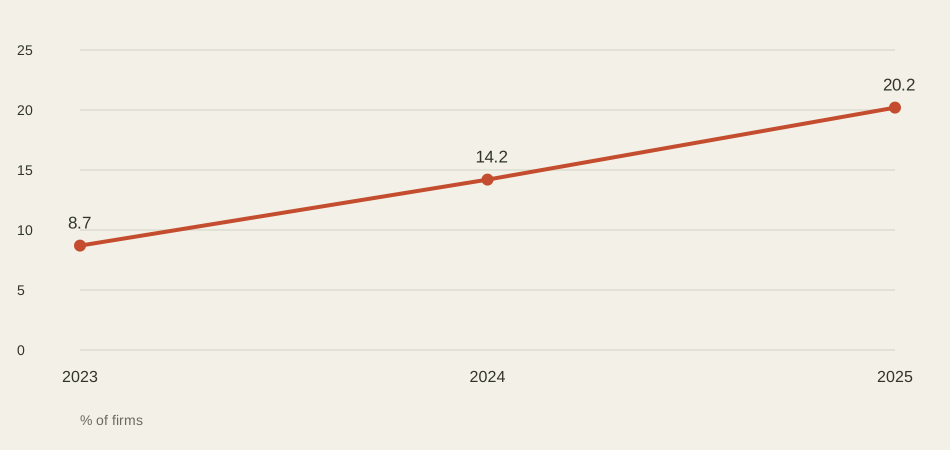
View the underlying data
| Category | % of firms |
|---|---|
| 2023 | 8.7 |
| 2024 | 14.2 |
| 2025 | 20.2 |
A gain is always a gain in something
A study published in the Quarterly Journal of Economics in 2025 followed 5,172 customer-support agents during the introduction of an AI assistant. Access increased issues resolved per hour by 15% on average. Effects differed across workers, and the research concerns a particular deployment in one firm. It does not establish an economy-wide productivity or employment effect. 2
The result is encouraging precisely because the outcome is specific. It identifies a measurable activity and a working context. A leadership team can use this discipline even when its work is harder to count. What would better performance look like in a planning department, a museum, a manufacturer or a community organisation? Which combination of speed, reliability, access and quality matters?
A single measure can easily become an instruction. Reward shorter handling time and staff may learn to end conversations quickly. Reward the number of reports and reports will multiply. AI makes the choice of measure more consequential because it expands the organisation's ability to produce whatever the measure rewards. The question is whether the organisation still values the result when it appears at scale.
The workflow contains a constitution
Every operating process distributes power. It decides who can initiate a task, who supplies information, which recommendation arrives first, who is allowed to object and who carries responsibility when things go wrong. An AI-enabled workflow makes these distributions through interface design as well as organisational policy.
Consider an illustrative approval system in which a model-generated recommendation appears in a prominent box while the evidence supporting an alternative takes several clicks to find. A formal policy may preserve independent judgement. The interface can still make one decision much easier to take than another. A person with nominal authority may find that the process continually steers them towards agreement.
Designing for meaningful judgement means providing time, information and a practical route for disagreement. An employee needs to know what they are responsible for checking. A manager needs to understand when the model is performing poorly. A person affected by the decision needs a way to obtain an explanation and correction. These are operating requirements that can be specified, tested and resourced.
Exposure is an invitation to investigate
The ILO's 2025 assessment estimates that one in four workers globally are in occupations with some exposure to generative AI. Its analysis concerns the potential susceptibility of tasks, rather than a forecast that a quarter of jobs will disappear. The organisation emphasises the continuing role of human input and the importance of managing the transition through social dialogue. 3
For an employer, the useful next step is therefore a closer examination of the work. Which tasks could be assisted? Which depend on relationships, tacit knowledge or professional interpretation? Which tasks look routine because their consequences are currently carried by someone else? A job title provides a rough location for the inquiry; it cannot replace it.
Employees should be involved in this examination because they often understand the exceptions that a process map omits. The workaround that looks inefficient may be protecting a client from a badly designed rule. The repeated phone call may be maintaining trust between departments. Removing such activities without understanding their function can increase the apparent efficiency of one part of a system while weakening the whole.
Decide where the dividend belongs
Suppose a team can complete the same reliable work with less effort. Several futures become possible. It could increase volume, improve quality, reduce prices, give staff more time, expand access or release resources for another purpose. Technology cannot choose among these futures on the organisation's behalf.
The allocation will usually emerge from existing pressures unless leadership makes it explicit. A backlog encourages greater throughput. A budget constraint encourages cost reduction. A professional service might choose deeper attention for difficult cases. The choices have commercial and human consequences, and different people may value them differently.
An honest transformation proposal should state the intended dividend and who is expected to receive it. If the ambition is better service, the organisation should specify how saved time reaches the service. If the ambition is a lower cost base, staff and partners should be able to understand the operating implications. This makes the business case more testable and gives the people doing the work a coherent account of its purpose.
Begin with the institution
ValueLab's Human Compatibility Framework offers a way to organise this wider examination. Questions about comprehensibility, agency, accessibility, context and the relationship over time belong inside a transformation brief. They help connect an organisation's declared purpose with the working conditions that purpose requires. This is a proposed application of the framework, rather than a claim of a measured client outcome.
A useful leadership session could examine one consequential workflow before approving a broader programme. Follow the task from the original need to the person affected by the final decision. Identify where knowledge enters, where judgement is exercised, how disagreement is handled and how capability develops. Then examine what a proposed tool would change at each point.
The result should be a set of decisions about work, responsibility and resources, alongside the technology choices. That gives an AI investment a clearer commercial and institutional foundation. It also preserves the most interesting ambition of the technology: the possibility of making an organisation capable of something more worthwhile than producing its existing outputs faster.
Sources & notes
Research checked 30 October 2026. This is an analytical essay. Illustrative situations are identified in the text; charts state their scope and limits.
- AI use by individuals surges across the OECD as adoption by firms continues to expand ↗OECD · 2026
- Generative AI at Work ↗The Quarterly Journal of Economics · 2025
- Generative AI and jobs: A 2025 update ↗International Labour Organization · 2025