
The dividend has more than one destination
A machine completes a task in minutes that once required an afternoon. The familiar promise is that people will have more time. Yet a saved hour can become several different things: another task, a higher target, a lower price, a larger margin or an hour genuinely released from work. The choice is economic and institutional as well as technological.
This is why the discussion about shorter working time belongs inside the discussion about productivity. A gain in productive capacity creates room for a decision. It does not allocate that room automatically. The worker who becomes faster may find their day fuller, particularly when the organisation has a backlog or competes by increasing output.
There can be good reasons to use a gain for more output. A public service may be struggling to meet demand. An enterprise may need a stronger financial position. The question is whether the distribution is being chosen deliberately, with a clear understanding of what people and the institution gain or give up.
What a working-time experiment can show
A 2025 study in Nature Human Behaviour examined six-month, income-preserving four-day-week interventions. It analysed 2,896 employees across 141 organisations in six countries, including Australia, and compared the pattern with 12 control companies. Participants reported improvements in several aspects of wellbeing. The organisations undertook work reorganisation before the trial. The design does not establish that every employer can remove a day with unchanged commercial performance. 1
The preparation is particularly interesting. A shorter week makes an organisation examine how it uses attention, coordination and presence. It can expose meetings that have lost their function, approvals that travel through too many hands, or habits of availability that are only loosely connected to useful work.
A thoughtful trial should investigate these conditions before promising a particular result. It should also examine what happens outside the participating team. If people achieve shorter hours by quietly passing work to a supplier or making a service harder to reach, the apparent dividend may depend on a cost that the trial has failed to count.
View the underlying data
| Category | million people |
|---|---|
| Women | 708 |
| Men | 40 |
The average working week conceals different lives
The ILO's global working-time review reported that over one-third of workers regularly worked more than 48 hours a week, while around a fifth worked fewer than 35. It also examined the mismatch between actual and preferred hours, particularly the difficulties associated with working longer than people wanted. These are global patterns assembled for the report, rather than a description of every national labour market today. 2
The figures warn against treating time as a single shortage shared in the same way. Some people need fewer paid hours; others need enough secure paid hours to support a household. A flexible professional role, an irregular hospitality roster and an unpaid caring responsibility create very different relationships with a calendar.
A policy designed around the salaried office worker can therefore miss the problem it means to solve. Working-time reform needs to consider income, predictability, control and the distribution of hours, alongside the total. A person may value knowing next month's roster as much as a reduction in nominal hours.
Care belongs in the calculation
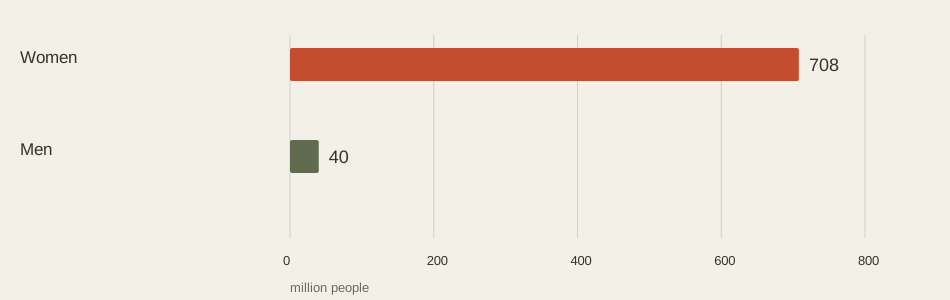
ILO estimates for 2023 found 748 million people aged 15 or older outside the global labour force because of care responsibilities: 708 million women and 40 million men. The estimates draw on data from 125 countries. The ILO warns that methodology changes prevent a direct comparison with its earlier estimates. These counts concern labour-force non-participation for care reasons, not the total number of people doing unpaid care. 3
The scale makes a simple point about what happens when paid work becomes shorter. A free day does not enter an empty world. It enters households where essential work is already being done, often unevenly. It may provide rest, enable a person to take on more care, or make room for another household member to enter paid employment.
None of these possibilities can be understood from payroll hours alone. A society interested in a more generous distribution of time also needs to examine care services, public transport, school schedules and household expectations. These arrangements determine whether a released hour becomes autonomy, recovery or another obligation.
The business model of a shorter day
For an organisation, the practical question is how a different allocation of time can remain financially and operationally viable. Some work can be reorganised around clearer priorities or more concentrated effort. Other work requires continuous coverage, a physical presence or a certain staffing level. The design problem varies with the service being delivered.
An illustrative small venue might experiment with fewer opening hours but more reliable trading periods. A professional firm might remove internal reporting that duplicates information already available. A service provider might stagger shorter schedules to maintain coverage. Each proposal has different implications for customers, colleagues, income and cost.
The discipline is to make the model explicit. What work changes? What revenue or service standard must be sustained? What resources are required? Who benefits? What evidence would make the organisation expand, alter or abandon the arrangement? These questions connect innovation, investment and impact without assuming that a desirable aspiration is already a workable model.
Protect the quality of the released time
Time has a texture. An afternoon that can be interrupted at any moment differs from an afternoon that a person can genuinely use. A nominal day away from work may offer little freedom when messages continue to demand immediate answers. Similarly, fragments of spare time can be difficult to turn into the sustained attention required for study, care, creative practice or friendship.
Working-time reform should therefore examine boundaries as part of its design. A shorter week may require clear arrangements for escalation, handover and availability. An organisation can explain which responsibilities continue and ensure that the person who is off duty is not silently expected to monitor everything.
The same principle applies beyond employment. Public services with unpredictable waiting times, long travel requirements or unnecessary repeat visits consume people's discretionary time. Improving those systems can create a time dividend even when a working week remains unchanged. This broadens the ambition from an employment benefit to the design of a more usable everyday life.
An economy with room to live
The most interesting question raised by productive technology is what people should be able to do with the capacity it creates. Greater output can improve material security and the quality of services. Greater freedom over time can support relationships, participation and forms of contribution that markets often struggle to recognise. A worthwhile future needs a considered relationship between these ambitions.
For institutions, that means evaluating a productivity proposal alongside its distribution. Record the intended gain in output, income, quality and time. Examine which groups receive each gain and which groups might carry additional costs. Track what actually happens after the arrangement changes. A shorter working-time experiment can become a useful way to learn about the organisation as a whole.
There is no universal calendar waiting at the end of technological progress. There are choices about how work is designed, how care is supported and what counts as prosperity. Making those choices visible gives the promise of more time a stronger foundation. It turns a comforting prediction into a practical question about the lives we want productive institutions to make possible.
Governments have a role in this inquiry as employers, service designers and organisers of shared infrastructure. Businesses have a role in deciding what their productivity gains are for. Households and communities have knowledge about the uses of time that a financial model may miss. The conversation becomes more useful when these perspectives meet around specific, testable arrangements.
Sources & notes
Research checked 30 October 2026. This is an analytical essay. Illustrative situations are identified in the text; charts state their scope and limits.
- Work time reduction via a 4-day workweek finds improvements in workers’ well-being ↗Nature Human Behaviour · 2025
- Working Time and Work-Life Balance Around the World ↗International Labour Organization · 2023
- Unpaid care work prevents 708 million women from participating in the labour market ↗International Labour Organization · 2024