
The succession problem hiding inside efficiency
A senior professional can recognise a weak answer because they have spent years producing, checking and defending answers themselves. Their judgement contains a history of mistakes, comparisons and consequences. An AI assistant can make some of that history available to a newcomer. It can also remove the occasions through which the newcomer would have built a history of their own.
This creates an institutional question that extends beyond whether today's output is correct. Who will have the capability to challenge tomorrow's output? If an organisation obtains its short-term gains by eliminating the activities through which people learn, it may gradually weaken the human capacity on which its assurance processes depend.
The problem deserves careful attention without becoming a story about inevitable intellectual decline. People have always used tools to extend their minds. A calculator, a reference library or a well-designed checklist can free attention for more demanding work. What matters is the relationship between the assistance, the task and the capability the institution needs people to retain.
What the evidence can tell us
A CHI 2025 study surveyed 319 knowledge workers and collected 936 examples of generative AI use. Higher confidence in the AI was associated with less reported critical thinking, while greater confidence in one's own task ability was associated with more. The findings concern self-reported experience and associations; they do not establish that using AI causes a general decline in intelligence. 1
The distinction improves the question. Rather than asking whether AI makes people cleverer or less clever, an organisation can ask when a particular arrangement encourages examination, verification and independent judgement. A tool that provides a fluent answer to every request may invite different behaviour from a tool that asks the person to compare evidence or explain a decision.
The useful unit of design is therefore the working relationship. What is the person expected to contribute? What does the assistant make easy? What demands are made by the surrounding institution? A conscientious employee may still struggle to exercise judgement if performance targets reward immediate acceptance and leave no time for investigation.
Assisted performance and acquired capability
Research published in PNAS in 2025 examined AI assistance in high-school mathematics. In a field experiment involving nearly a thousand students, access improved performance during assisted practice, but an unguarded version was associated with worse results when the tool was later removed. A version designed to safeguard learning largely mitigated the negative effects. This is evidence about a particular educational setting, rather than a direct finding about experienced professionals. 2
The study points to a distinction worth carrying into organisational design: performing a task with help and becoming able to perform it are different achievements. A workplace may need both. During an emergency, dependable assisted performance may be the priority. During apprenticeship, the process of acquiring capability deserves explicit protection.
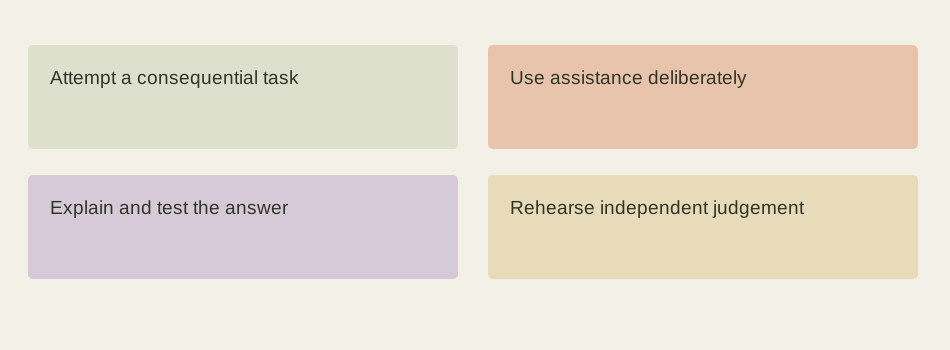
An illustrative professional-development arrangement could therefore separate supported delivery from learning practice. Staff might use an assistant for real work while periodically solving selected problems independently, comparing approaches and discussing errors. The point would be to reveal whether understanding is growing and which kinds of support help it grow. Such a programme would require evaluation in its own setting.
Human involvement needs a job
It is easy to assume that a person plus an AI system will be better than either alone. A 2024 meta-analysis of 106 experimental studies found a more complicated picture: combined systems performed better than humans alone on average, but worse than the better of the human or AI working alone. Results varied by task and study design. 3
This does not tell an institution to remove people from decisions. Performance on a specified task is only one reason to involve a person; responsibility, legitimacy, care and the possibility of appeal can also matter. It does tell us to specify what human involvement is meant to achieve and whether the arrangement actually supports that contribution.
A reviewer who sees only the assistant's preferred answer may be poorly positioned to identify its omissions. A reviewer who can examine underlying material, compare alternatives and ask for clarification has a more substantial role. Their presence becomes more valuable when the process is designed around the information and judgement they can contribute.
Designing a continuing capacity to disagree
Meaningful disagreement needs more than permission. It needs an intelligible object to disagree with, enough knowledge to recognise a problem, time to investigate and a route through which the objection can alter the outcome. An employee who lacks any of these conditions may remain formally responsible while becoming practically dependent.
Institutions can make these conditions visible. A consequential recommendation might identify the evidence used, distinguish assumptions from observations and state which questions remain unresolved. A review process can provide access to alternative material and record the reason for accepting or rejecting an output. A manager can recognise justified escalation as useful work rather than treating every interruption as friction.
There is a commercial argument for this as well as an ethical one. An organisation that cannot identify when its tools are wrong has a weak basis for relying on them. Its capacity to disagree is part of its capacity to learn from a changing environment. Protecting that capacity can make investment in technology more durable.
Keep a portfolio of learning opportunities
Learning often happens in apparently ordinary work: preparing a first draft, testing a calculation, explaining a recommendation to a colleague, dealing with an unusual request. These activities have a production function and a developmental function. If automation is assessed only against production, the developmental contribution can disappear from view.
One practical response is to identify a small portfolio of tasks through which people develop essential judgement. Some may remain largely independent exercises. Others may be redesigned so an assistant explains options rather than supplying a conclusion, or so staff compare multiple approaches before choosing one. Experienced practitioners can help identify where struggle is productive and where it is merely wasteful.
This should be selective. Requiring people to repeat every task unaided would impose costs and frustrate the benefits of assistance. The aim is to retain the capability required for the organisation's future, not to preserve every familiar activity. That requires a view of what kinds of professional contribution will continue to matter.
The staffing model matters here. An organisation may expect its senior people to provide assurance while giving them no time to mentor, review or develop successors. Technology can expose that existing inconsistency. A credible capability plan should connect the learning opportunities to workloads, promotion and the responsibilities people are expected to assume later.
Compatibility over time
The Human Compatibility Framework directs attention to how a relationship develops. An arrangement that is useful in its first week may create increasing dependence over a year. Another may gradually expand a person's understanding and range of action. The difference becomes visible through questions about comprehensibility, agency and reversibility, as well as immediate convenience.
A useful evaluation would therefore include more than output quality and time saved. Can people explain why an answer is credible? Do they recognise the tool's limitations? Can they handle selected tasks when assistance is unavailable? Are new staff gaining enough experience to become trusted reviewers themselves? These are proposed organisational questions, not a validated universal scoring instrument.
The most promising future is one in which assistance expands both achievement and capability. Reaching it requires deliberate choices about work and learning. Institutions will need people who can understand what they have built, recognise when it has stopped working and imagine what should come next. That human contribution deserves a place in the original design.
Sources & notes
Research checked 30 October 2026. This is an analytical essay. Illustrative situations are identified in the text; charts state their scope and limits.
- The Impact of Generative AI on Critical Thinking: Self-Reported Reductions in Cognitive Effort and Confidence Effects From a Survey of Knowledge Workers ↗Microsoft Research / CHI 2025 · 2025
- Generative AI without guardrails can harm learning: Evidence from high school mathematics ↗Proceedings of the National Academy of Sciences · 2025
- When combinations of humans and AI are useful: A systematic review and meta-analysis ↗Nature Human Behaviour · 2024