
The public consequence of an ordinary decision
A community enterprise can have a generous mission and a lease that makes generosity impossible. A service can promise accessibility while depending on prices that exclude the people it hopes to reach. A fund can describe its commitment to patient change while requiring an exit before the institution it supports has found its feet. These tensions are often treated as problems of implementation. They begin much earlier, in the arrangements that determine how the work survives.
Every operating model contains an account of whose time matters, what deserves payment and who can absorb uncertainty. Those choices distribute benefits and burdens long before an annual impact report describes them. Thinking about the business model as part of the public good therefore changes the design question. We have to examine the revenue, costs, rights and responsibilities through which the purpose becomes an everyday reality.
A more useful conversation than charity versus business
The OECD’s review of the social and solidarity economy documents a diverse field of purposes, legal forms, business models and practices. That variety matters: there is no single organisational costume in which useful social activity must appear. An enterprise can trade while pursuing a social purpose; an organisation can rely on donations while operating with rigorous commercial judgement. The legal form is important, but it cannot carry the whole explanation of what an institution does.1
The more productive questions concern the actual arrangement. Who pays, and for what? Who benefits without paying? Where does surplus go? Who decides when the financial and social objectives conflict? An organisation that can answer these questions has moved beyond an attractive description of its intentions. It has begun to explain how those intentions will survive pressure, including the ordinary pressure of paying people properly and keeping the doors open.
Innovation, investment and impact belong in the same drawing
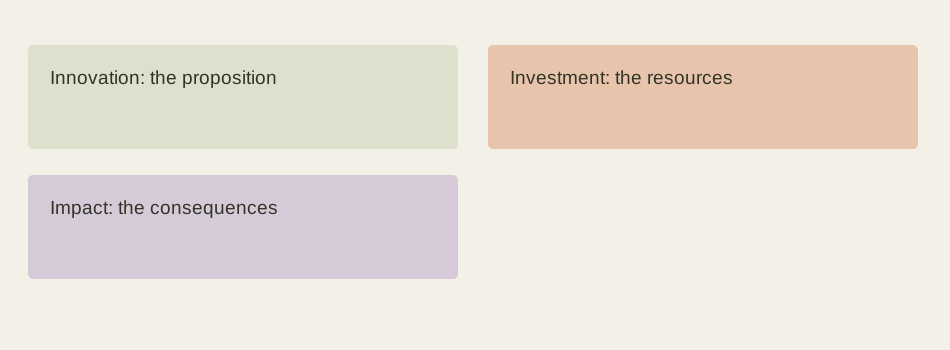
ValueLab’s Triple-I vocabulary offers a way to hold three questions together. Innovation concerns the proposition: what could work differently? Investment concerns the resources and commitments that make the proposition possible. Impact concerns the consequences: what changes for whom, and over what period? These are connected design considerations. They should be revisited when one of the others changes.
Consider an illustrative operating hub containing small enterprises, shared facilities and community programmes. A new programme might bring people who would otherwise have little reason to visit. It might also require a host, insurance, cleaning and subsidised access. The financial question is not merely how to recover those costs. It is whether the programme strengthens the overall proposition, which participants can contribute, and which benefits require an external purchaser or a deliberate subsidy. The answer changes the model.
A subsidy can be an explicit purchase
It is tempting to describe earned revenue as independent and subsidy as a weakness. In practice, many valuable activities generate benefits for people who are not the immediate customer. A public purchaser, foundation or member group may choose to pay for those benefits. The important discipline is to say what is being purchased, why that payment is justified and how its continuation will be assessed.
The OECD’s work on social procurement examines how public and private purchasing can create social dividends and the market-access barriers faced by social economy organisations.2 The implication for a commissioner is practical. A purchase specification should describe the service and the additional public purpose clearly enough to be delivered and evaluated. The implication for an operator is equally practical: goodwill is a poor substitute for knowing which costs a contract actually covers.
Build the cost of care into the budget
An organisation can appear efficient because somebody is supplying an invisible input. It may be a founder repeatedly working without pay, a casual employee doing unrecorded coordination, or a volunteer absorbing the emotional work that a formal service has not budgeted for. Such contributions can be freely chosen and enormously valuable. They become a design problem when the model quietly assumes they are unlimited.
A useful budget makes these inputs visible even when they are donated. It separates the cost of a service from the price charged to a participant and from the identity of the payer. That separation allows an honest conversation about affordability. It also shows what would have to change if a key volunteer leaves, a founder steps back or a temporary grant ends. Resilience begins with understanding the work on which the model depends.
Evidence should improve the operation
The OECD and European Union’s impact guide treats measurement as something to integrate into decisions, stakeholder engagement and organisational learning.3 That is a more useful ambition than producing an impressive collection of numbers at the end of a year. A small amount of well-chosen evidence can help an operator notice who is missing, which activity is useful and where the costs of participation are falling.
The distinction between an output and an outcome remains important. A workshop count records delivery; it does not establish that participants gained lasting capability. A strong attendance figure may coexist with a narrow audience. A participant story can reveal something a count misses, while still being one person’s experience. The practical task is to combine operational records, participant accounts and proportionate evaluation so that decisions become better informed. Large claims need a correspondingly stronger basis.
Match the funding clock to the work
The time horizon deserves its own scrutiny. A short project grant can be appropriate for an experiment with a clear end. It becomes a poor fit when the desired benefit depends on people gradually coming to trust a service or on an enterprise building a dependable customer base. A mismatch between funding time and social time can produce repeated launches, interrupted relationships and a continual diversion of attention towards the next application.
One way to examine that mismatch is to lay out the commitments year by year. Which costs establish the activity, and which recur? When are customers or participants likely to find it useful? What capacity has to be retained between programmes? What happens at the point when a funder expects the work to become independent? This exercise cannot remove uncertainty. It can reveal which assumptions require testing and which parties are being asked to carry the risk of an unrealistic timetable. An honest agreement about that risk is a valuable part of the public-purpose model.
Governance is where the promises meet
The hardest choices rarely arrive as a tidy conflict between greed and goodness. They arrive as two worthwhile activities competing for a room, a subsidy or a manager’s time. They arise when an enterprise needs higher prices to remain solvent or when the most commercially attractive tenant changes the character of a shared place. A mission statement offers direction, but somebody still needs authority to decide.
The model should make that authority legible. It should explain which interests have a voice, how trade-offs are recorded and what can be reconsidered. Otherwise, the institution’s public purpose rests too heavily on the judgement of whoever happens to be present. Clear governance allows judgement to be exercised and challenged. It also helps investors, staff, partners and participants understand the commitments they are joining.
Design for a worthwhile continuation
The practical invitation is to put the purpose and the operating model on the table together. Begin with the activity and the people whose lives it is meant to affect. Trace the resources it needs, the benefits it creates and the parties able to pay for different parts of that value. Then examine the time horizon, the distribution of risk and the decisions that could gradually pull the organisation away from its purpose.
A viable model gives worthwhile work the possibility of continuing. A socially grounded model asks what that continuation makes possible for others. Holding the two together opens a more demanding and more interesting form of enterprise: one in which commercial design is itself a place to exercise responsibility. The public good is shaped in the contract, the roster, the price, the lease and the allocation of surplus. That is where an ambitious intention becomes an institution people can rely on.
Sources & notes
Research checked 30 October 2026. This is an analytical essay. Illustrative situations are identified in the text; charts state their scope and limits.
- What is the social and solidarity economy? A review of concepts ↗OECD · 2023
- Buying social with the social economy ↗OECD · 2023
- Measure, Manage and Maximise Your Impact: A Guide for the Social Economy ↗OECD/European Union · 2024