
What happens after the ranking
A city can perform well in a ranking and still be difficult to form a life in. It may have excellent hospitals, attractive streets and reliable infrastructure while the places in which people can meet have become expensive, distant or conditional on consumption. Equally, a modest neighbourhood can hold a remarkable richness of association: familiar faces, useful shops, shared rituals and small institutions that make daily life feel connected.
Lovability is one way to ask about that richness. It is not a technical index in this article, and it does not replace the essential questions of safety, housing, access and services. It describes a relationship: whether a place gives people reasons to return, participate and take responsibility for what they share. That relationship deserves attention alongside the attributes that are easier to compare.
Averages can introduce the question, not settle it
The European Commission’s 2023 quality-of-life report found that 87% of people in the European cities included in its survey were satisfied with living in their city. This is a result for the surveyed cities, not a global measure, and satisfaction with a city is not the same as an assessment of every part of life within it. The report examines differences across residents, cities and aspects of urban experience.1
The number offers a useful reminder that cities can be sources of real attachment and satisfaction. It also leaves important questions open. Who finds the city affordable? Who can use its public spaces comfortably? Who has a reason to stay when their employment, income or family circumstances change? A high average can coexist with a narrow set of possibilities for particular groups. The work of understanding a place begins when the average is opened up.
Look at an ordinary journey
The World Health Organization’s age-friendly cities work considers outdoor spaces, transport, housing and participation as connected aspects of an enabling environment. Its original guide drew on focus groups with older people, caregivers and service providers in 33 cities across 22 countries.2 That perspective gives an especially concrete way to examine the quality of urban life: follow the sequence of things a person must be able to do.
Consider an illustrative afternoon trip to a community event. The person needs understandable information, a manageable journey, a safe crossing, somewhere to rest, an accessible entrance and a way to get home. A failure at any point may prevent participation, even if the venue itself is excellent. This is why a bench, a toilet or a predictable timetable can carry more social significance than its modest appearance suggests.
The city has to be reachable at more than one price
Affordability concerns more than the cost of a home. It includes the price of occupying the city after leaving it: a journey, a meal, an activity, a place to sit or a reason to gather. Some of these experiences can be commercially provided. Others depend on libraries, parks, community organisations, civic rooms and the less visible subsidies that allow them to operate.
A city that offers belonging only through paid consumption leaves fewer options for people with little discretionary income. This does not make small hospitality and cultural businesses incidental to civic life; they often contribute greatly to it. It means the broader mix matters. Public provision, affordable enterprise and shared facilities can offer different routes into participation. Each requires a realistic account of its costs, its responsibilities and the people it is intended to serve.
Public space has an operating life
UN-Habitat’s work on public space explicitly addresses legislation, governance and finance alongside its physical form.3 That wider scope matters because a space can be legally public and practically unwelcoming, or beautifully designed and poorly maintained. The lasting value of the place depends on the arrangements that continue after the opening photographs have been taken.
Those arrangements include cleaning, maintenance, lighting, access, booking rules and the way competing activities are negotiated. A market, a children’s activity and a quiet conversation may all belong in a shared place, while requiring different conditions. The design task extends to the people who host the space and the resources that allow them to respond. A capital allocation that provides no credible operating provision leaves a substantial part of the project unresolved.
Make room for the small and particular
Places gain character through the particular forms of life they accommodate. A repair business, a rehearsal room, a small gallery or an unhurried food stall can provide reasons to visit that a standard tenancy mix would miss. Their value may be partly commercial and partly relational. They may support a neighbourhood’s identity, introduce people to one another or give an emerging practice somewhere to develop.
This does not mean every fragile enterprise should be preserved indefinitely. It means a landlord, public authority or institution needs to understand what may be lost when an apparently interchangeable use disappears. Decisions about rents, lease length, fitout requirements and permissible activity influence which kinds of enterprise can exist. A cultural ambition without attention to those conditions risks producing a place that speaks about diversity while becoming progressively more uniform.
Give continuity a place in the calculation
Urban life depends on a mixture of change and continuity. A new use can bring energy, employment and different kinds of participation. An existing use may carry a history of relationships that takes years to form and little time to displace. The practical issue is how decisions recognise both. Continuity has consequences for a shopkeeper planning investment, an artist establishing an audience or a community group deciding whether to spend its limited resources on a shared facility.
Longer commitment is not always possible or desirable. Temporary use can create genuine value if its terms are understood and the investment required is proportionate. Difficulty arises when an institution invites people to develop a place and then treats their contributions as irrelevant to its next decision. Clear agreements about duration, improvements, exit and review can support imagination without disguising uncertainty. They allow people to judge what to build together, and to invest their time with a more realistic understanding of the future.
A place can invite stewardship
People may be more willing to care for something when they can understand how to contribute and when that contribution is received seriously. A shared garden, local programme or neighbourhood association creates possibilities for such involvement, but only if its expectations are clear. Endless unpaid responsibility can exhaust the same committed people who make a place feel welcoming in the first place.
An operating model can distribute care more deliberately. It can distinguish professional work from voluntary participation, create modest opportunities to help and provide a route for suggestions to affect decisions. This is an analytical proposition rather than a claim that a particular governance format guarantees attachment. Its practical test is whether more people can participate without the institution relying on a small group to quietly absorb every unmet need.
Ask what kind of life the place permits
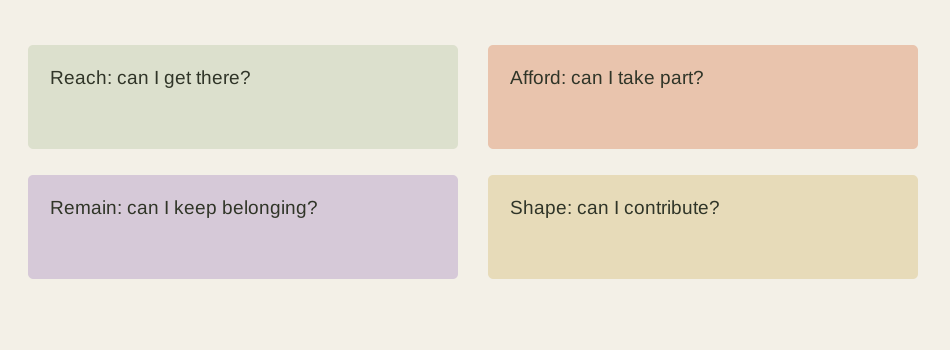
A useful place strategy can begin with four plain questions. Can people reach the opportunities the place offers? Can they afford to participate? Can they remain connected as their circumstances change? Can they influence something about its future? Together these questions draw attention to transport, prices, tenure, services, culture and governance without pretending they can all be reduced to a single score.
For a city, institution or operator, the challenge is to connect an appealing vision of public life to the arrangements that sustain it. A place becomes worth staying in through repeated encounters with something useful, generous, interesting or familiar. Much of that experience is made possible by ordinary decisions about land, budgets, business conditions and time. Lovability gives us a reason to take those decisions seriously: they shape whether people merely occupy a place or can make a shared life there.
Sources & notes
Research checked 30 October 2026. This is an analytical essay. Illustrative situations are identified in the text; charts state their scope and limits.
- Report on the quality of life in European cities, 2023 ↗European Commission, DG Regional and Urban Policy · 2023
- The WHO Age-friendly Cities Framework ↗World Health Organization · 2007
- Legislation, Governance and Finance of Public Spaces ↗UN-Habitat · n.d.