
Start with the life the home must support
A housing project can be technically complete while the arrangement around it remains unfinished. There may be no clear answer about a repair, an uncertain path when a resident’s needs change or a financial model that works only while someone else absorbs a recurring cost. These are housing questions as surely as the number of bedrooms or the construction programme. A home supports a pattern of life. The design of the wider system determines how secure, usable and affordable that pattern can be, and whose responsibility it becomes when circumstances shift.
Consider an illustrative person trying to live independently near work and family. The cheapest available dwelling may require a costly journey. A better-located home may have an entrance that is difficult to use. A physically suitable property may be offered on an arrangement whose uncertainty makes it hard to plan. Each option can look adequate when considered through one professional lens. The person has to live with their combined effects. A useful housing strategy therefore examines the relationship between physical provision, ongoing costs, tenure, services and location, rather than treating each as a separate problem to be solved later.
Australia already has several housing systems
The 2021 Census recorded that 31% of occupied private dwellings were owned outright, 35% were owned with a mortgage and 30.6% were rented. The categories do not exhaust every tenure response, and these are Census-era figures, not a snapshot of today’s market. They nevertheless show why an account of housing organised entirely around the purchaser is incomplete. Renters, mortgaged owners and outright owners encounter different costs, responsibilities and kinds of uncertainty. A policy that improves one group’s position can affect the conditions faced by another. 1
Tenure is often discussed as a ladder with a single preferred destination. For practical design, it is also an allocation of rights, obligations and exposure to change. Who must maintain the building? Who can decide whether an adaptation is made? What happens when a household grows or loses income? What continuity can a resident expect? These questions do not require every household to choose the same arrangement. They require each arrangement to be legible enough that residents and providers understand what they are taking on, and resilient enough to accommodate ordinary changes in people’s lives.
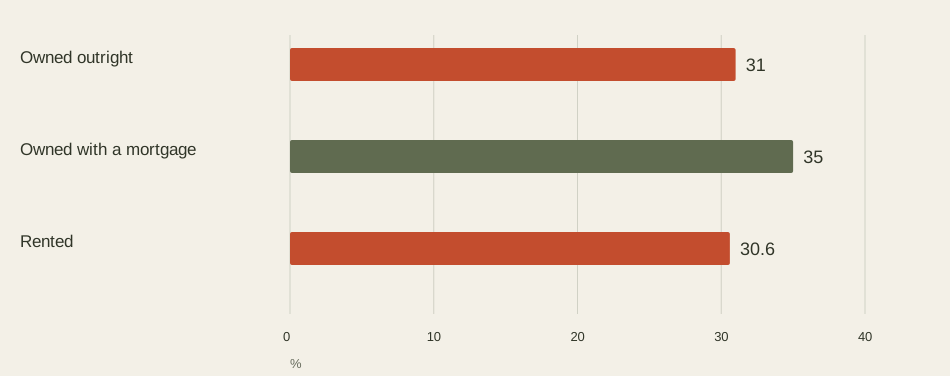
View the underlying data
| Category | % |
|---|---|
| Owned outright | 31 |
| Owned with a mortgage | 35 |
| Rented | 30.6 |
Affordability is a relationship, not a price tag
A dwelling’s cost becomes meaningful in relation to the resources of the people using it. AIHW’s 2025 housing-assistance report found that, at June 2024, 42% of income units receiving Commonwealth Rent Assistance remained in rental stress after the payment. The report defines the measure as spending more than 30% of gross income on rent and distinguishes an income unit from a household. It is a finding about recipients of a particular assistance programme, rather than a prevalence estimate for all Australians. Even within that limited scope, it demonstrates that the existence of financial support does not establish affordability. 2
For a provider, the total household burden may extend beyond the rent. Transport, energy, service costs and the expense of moving can shape whether a housing arrangement is manageable. For a resident, the cost of uncertainty can matter too: the time spent seeking another place, the effort of changing schools or the disruption of losing nearby support. These costs are difficult to reduce to one universal formula. They are still real design considerations. A proposition that advertises a low entry price while exporting substantial ongoing costs elsewhere should be examined as a whole, using assumptions that are clear enough to challenge.
Finance carries a view of the future
An investment model contains expectations about income, costs, risk and time. In housing, those expectations influence the kind of home that can be offered and the changes a provider can tolerate. A model requiring rapid increases in revenue will create different pressures from one supported by patient resources and a long operating horizon. The point is not to declare one financing instrument inherently good. It is to understand how the chosen arrangement behaves under plausible conditions, including periods when costs rise, a building needs work or a resident’s circumstances change.
This brings governance into the financial conversation. What is protected when a difficult trade-off appears? Who has authority to act, and what information do they receive? Where does the cost of a concession land? A housing provider needs enough financial strength to maintain its commitments. Residents need those commitments to remain meaningful when maintaining them becomes inconvenient. A credible design describes how these interests are held together, rather than relying on the assumption that goodwill will fill any gap. The financial model should reveal the conditions under which the purpose can continue, including the circumstances in which it would need revision.
Accessibility is part of ordinary housing quality
Physical accessibility is frequently deferred until someone can identify a particular future resident who needs it. That approach can make adaptation reactive and expensive. The Australian Building Codes Board’s Livable Housing Design handbook describes features including a step-free entrance and circulation considerations. Requirements and implementation vary, so a project must establish the provisions applicable to its own circumstances. The broader design point is straightforward: a home can anticipate a wider range of bodies and changing abilities. A feature that enables one resident to enter independently can also make everyday tasks easier for visitors, families and people recovering from injury. 3
Usability also involves the arrangements surrounding the building. A maintenance request that can be made only through an inaccessible interface can undermine an otherwise usable dwelling. Information may need to be provided in a form a resident can understand. Responsibility between housing, support and other services needs to be clear enough that an individual is not left managing institutional gaps. Housing and support can have distinct roles while still being coordinated around the person’s experience. Good boundaries describe responsibility; poor boundaries send someone from one unanswered enquiry to another.
The neighbourhood completes part of the proposition
A home’s location affects the work, relationships and services a resident can reasonably reach. The OECD’s housing-policy work treats affordability, inclusion, economic functioning and environmental consequences as connected objectives, with trade-offs across levels of government. That integrated perspective is useful because a dwelling cannot supply every condition of a good life within its own walls. Applying it locally requires attention to a specific place, including the transport, services and opportunities that already exist and the pressures additional housing may create. 4
An affordable home far from relevant opportunities may impose an expensive pattern of living. A well-connected home can still be difficult to use when the local environment is hostile or the services required are unavailable. This does not establish a single ideal neighbourhood form. It suggests that a project’s account of value should include the daily routes and relationships its residents are likely to depend on. Consultation is most useful when it tests those practical assumptions early enough to influence the proposition, rather than simply asking for approval of a design whose underlying commitments are already fixed.
Evaluate the arrangement after it opens
Completion marks the beginning of a dwelling’s operating life. A proportionate evaluation asks whether maintenance occurs as expected, whether residents understand how to raise issues, whether costs are tracking the assumptions and whether the arrangement continues to suit its intended users. Different kinds of evidence answer different questions. Financial records cannot, by themselves, establish an experience of security. A positive resident account cannot, by itself, demonstrate that a provider can fund future maintenance. Both deserve a place in assessing whether the model is working, with an appropriate respect for residents’ privacy and autonomy.
For ValueLab, the upstream question concerns how the pieces fit: purpose, resources, institutional responsibilities and human experience. The place-based delivery work then needs its own specialist knowledge and accountable operating arrangements. A dwelling can be traded as an asset. Housing as a continuing proposition is designed through the relationship between people and those arrangements. The strongest models make that relationship understandable, economically credible and capable of adapting over time. Their value is visible in an ordinary achievement: someone can get on with a life, with fewer unnecessary obstacles created by the system around their home.
Sources & notes
Research checked 30 October 2026. This is an analytical essay. Illustrative situations are identified in the text; charts state their scope and limits.
- Housing: Census, 2021 ↗Australian Bureau of Statistics · 2022; Census reference year 2021
- Housing assistance in Australia 2025: Financial assistance ↗Australian Institute of Health and Welfare · 2025; June 2024 data
- Livable Housing Design handbook, version 1.1 ↗Australian Building Codes Board · 2022/2023
- Brick by Brick: Building Better Housing Policies ↗OECD · 2021