
The building is only the beginning
A new cultural building offers an unusually satisfying image of public ambition. It can be photographed, opened, named and counted. The less photogenic conditions around it determine much of what happens afterwards: whether a musician can afford rehearsal time, whether someone answers a community group’s enquiry, whether there is money to open on a quiet afternoon, and whether a young person feels able to cross the threshold. Cultural infrastructure includes the arrangements that allow these ordinary things to happen repeatedly. A capital project can contribute to those arrangements. It can also consume the resources they need.
Treating culture as infrastructure begins by taking that operating life seriously. Consider an illustrative regional arts centre with a respected auditorium and an unreliable programme. Another centre has a modest hall, a capable producer, predictable opening hours and relationships with local schools. The comparison is not a verdict on architecture. It reveals a different unit of analysis: the capacity to support a continuing cultural life. The relevant investment question concerns a whole arrangement of people, buildings, skills, distribution and trust, rather than the prestige of an individual component.
A population participates in more ways than one
Creative Australia’s 2022 National Arts Participation Survey reported that 97% of Australians aged 15 and over engaged with the arts in some form, while 68% attended live. These are broad measures, encompassing very different experiences; they should not be read as evidence that everyone regularly visits a major institution. The same study found that 49% wanted to attend more than they did, with cost and location continuing to present barriers. The findings suggest a population with an appetite for cultural life and uneven opportunities to exercise it. They do not establish that another flagship venue is the best response. 1
Comparison across surveys needs care. The ABS measures selected activities and venues using a different collection. It recorded adult attendance of 82.4% in 2017–18 and 63.8% in 2021–22; the latter reference period spanned July 2020 to June 2022 and was affected by pandemic restrictions. Participation in making selected cultural activities was much steadier: 31.4% and 32.2%. These figures describe a disrupted period and different kinds of involvement. They are not a current attendance forecast. They are useful because they make visible a distinction between reaching an event and continuing to create. 2
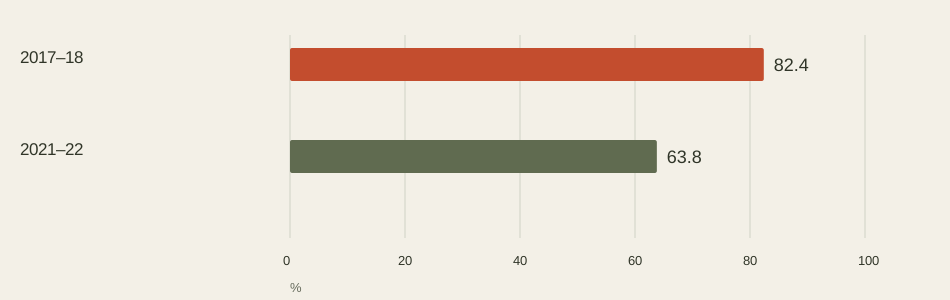
View the underlying data
| Category | % |
|---|---|
| 2017–18 | 82.4 |
| 2021–22 | 63.8 |
What the economic account can tell us
Economic evidence can establish that cultural activity involves employment, purchasing, training and enterprise. It can help public bodies recognise consequences that sit outside a narrowly defined arts budget. A small venue may buy from local suppliers and support production skills as well as sell tickets. Those are legitimate parts of an investment discussion. The account becomes less useful when every cultural choice must be defended through an increasingly elaborate multiplier, as though an evening of music acquires its justification only after someone estimates its effect on neighbouring restaurant sales.
The harder institutional task is to hold several accounts together without collapsing them into a single score. A cultural programme may have strong artistic importance, limited ticket income, substantial participation value and considerable delivery costs. Different funding arrangements may be appropriate for different parts. Commercial activity can support continuity; public or philanthropic support can preserve access and experimentation. The relationship should be explicit enough that managers understand what income is expected to do, what a subsidy is purchasing and what cultural freedom needs protection. Financial clarity can give a cultural ambition more room to breathe.
Access is an operating decision
Participation depends on much more than a ticket price. Transport, opening hours, booking conventions, sensory environments, language and the expectation of prior knowledge all shape who can take part. An organisation can declare itself welcoming while its ordinary procedures send a more complicated message. A late announcement makes attendance harder for someone arranging care. A digital-only booking process can close a door before the building opens. A room that requires continuous consumption may allow entry while restricting the length of time a visitor can comfortably remain.
These observations suggest practical design work rather than a universal formula. Teams can examine a particular journey from first hearing about an activity to arriving, participating and returning. People affected by the barriers should help interpret that journey. The resulting changes may be small in physical scale and significant in experience: an earlier schedule, a familiar host, a clearer description, a different time or an alternative route to booking. The achievement is an organisation that learns where its offer fits people’s lives and has the authority and resources to adjust it.
A cultural institution belongs to an ecology
The OECD and ICOM’s guide on culture and local development places museums within a wider agenda involving economic development, regeneration, creative societies, inclusion and wellbeing. Its significance is the invitation to agree a local agenda with communities and governments, rather than assume a museum’s presence automatically supplies all those benefits. The guide is about museums; applying the principle to a music venue or neighbourhood cultural hub is an extension of its reasoning, not a reported finding from the document. 3
For a funding body, that wider view changes the questions asked of a project. What smaller organisations will gain an opportunity to present work? Who will develop technical skills? What can be shared without eroding the independence of the participants? Where could a new institution compete for the same scarce staff, audiences and money? An ecology can be weakened by an impressive centre if its success draws resources away from the places where new work begins. It can be strengthened when the centre offers reliable pathways, facilities and relationships that others can actually use.
The future requires room for work we cannot predict
There is a democratic dimension to this question. Article 27 of the Universal Declaration of Human Rights recognises participation in cultural life and enjoyment of the arts, alongside participation in scientific advancement. That provides a basis for discussing culture as part of a shared life rather than a reward distributed after more serious public business is complete. It does not settle which building to fund or which programme deserves support. Those choices still require judgement, transparent reasons and attention to the people who will live with the consequences. 4
A system that funds only activities able to prove their future popularity is likely to favour familiar producers and established audiences. That can be commercially sensible for a particular programme and limiting as the rule for an entire cultural system. Some capacity should exist for work whose audience, language or form is still emerging. The challenge is to make that capacity accountable without demanding that discovery resemble a predictable service contract. A portfolio can distinguish dependable provision, developmental work and experimentation, giving each a funding horizon and a proportionate account of what has been learned.
Fund the conditions for a cultural life
A useful cultural-infrastructure brief therefore includes an operating model alongside a spatial one. It identifies recurrent costs, responsibility for maintenance, access arrangements, the role of earned income and how decisions will adapt as use becomes clearer. It considers the surrounding ecosystem and the people who are currently missing from it. It also describes the cultural ambition in terms that retain the possibility of surprise. The financial model should make the work sustainable enough to continue, without quietly replacing the purpose with whichever activity is easiest to sell.
The practical test arrives a year after the launch, on an ordinary afternoon. Is there a reason to come? Does someone have the capacity to host well? Can a developing practitioner afford to try something? Can the institution change a rule that has become an obstacle? These questions are less spectacular than an opening announcement, but they describe an infrastructure that is working. Culture becomes durable when a society supports the everyday arrangements through which people make, share and encounter it. That is a substantial investment proposition—and a worthwhile public ambition.
Sources & notes
Research checked 30 October 2026. This is an analytical essay. Illustrative situations are identified in the text; charts state their scope and limits.
- Creating Value: Results of the National Arts Participation Survey ↗Creative Australia · 2023; survey 2022
- Creative and cultural engagement ↗Australian Bureau of Statistics · 2025; reference periods 2017–18 and 2021–22
- Culture and local development: maximising the impact ↗OECD / ICOM · 2019
- Universal Declaration of Human Rights, Article 27 ↗United Nations · 1948