The calendar is already an argument
An invitation to live well often arrives as another task. Read more. Exercise. Cook. Learn something difficult. Make time for friends. Pay attention. These are worthwhile things to do. They also require time with a particular quality: time that is sufficiently predictable, sufficiently yours and sufficiently free from competing obligations to support a choice.
The difference between an aspiration and a practical possibility can be as ordinary as a school collection, a roster published late, a bus that stops running before a shift ends or an appointment system that assumes everyone is available during business hours. The shape of a day is partly personal and partly institutional. When we discuss only motivation, we leave a substantial part of that design untouched.
This is why the everyday deserves a place in conversations about strategy and social change. An institution can have a persuasive mission and still organise daily life in ways that exhaust the people expected to carry it out. Equally, a modest change to a timetable or an expectation can make an ambitious personal practice possible. The connection runs in both directions.
Count the work that the calendar hides
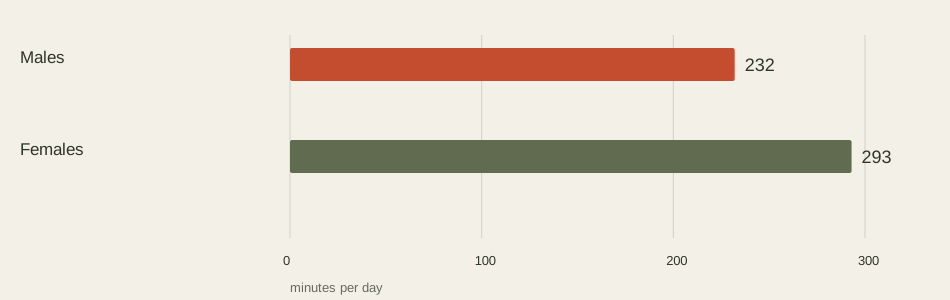
The Australian Bureau of Statistics’ 2024 Time Use Survey makes part of this arrangement visible. Among people who undertook unpaid work on their diary day, females reported an average of four hours and fifty-three minutes, compared with three hours and fifty-two minutes for males. These are participant averages, not an allocation applying to every Australian. The category includes domestic work, care and voluntary activity. 1
The chart gives those figures a common scale. Its purpose is to show a difference in reported time, not to rank the worth of activities or explain every household. A national average cannot tell us who has support, who enjoys a particular task or how responsibility is negotiated. It does remind us that the work sustaining ordinary life occupies real hours, whether or not those hours produce a wage.
Measurement matters here. The survey collected diaries for two consecutive days, and the ABS warns that changes in method limit comparisons with earlier collections. We should resist drawing a smooth historical story from figures that were collected differently. A useful account of everyday life can be precise about its limits and still reveal questions that economic reporting routinely misses. 2
View the underlying data
| Category | minutes per day |
|---|---|
| Males | 232 |
| Females | 293 |
An average is not a timetable
There is another distinction worth making: a quantity of free time does not describe its usability. An hour in an uninterrupted block can support a rehearsal, a swim, a sustained conversation or difficult reading. Four intervals of fifteen minutes, each waiting for the next obligation, offer a different kind of opportunity. Counting both as sixty minutes may be correct while leaving the experience largely unexplained.
Consider an illustrative household with two adults whose work schedules change each week. They may be able to purchase some flexibility, but they cannot reliably join a group that meets every Thursday. An employer’s scheduling decision therefore reaches beyond its own premises. It changes the conditions under which its workers can participate in civic, cultural and family life.
The same issue appears inside an organisation. A calendar scattered with short meetings can leave ample nominal time for professional judgement and almost no occasion to exercise it. A team may be busy, responsive and conscientious while rarely having the attention needed to understand a problem in depth. The problem is visible in the arrangement of the day before it appears in a strategy review.
Personal practice needs an environment
The Daily 8s sits within ValueLab’s interest in the habits through which people develop their capacity to live and contribute. A personal practice can give shape to attention and help a person act on something they value. Its existence does not settle the question of whether a workplace, household or service makes that practice feasible. Both levels deserve serious consideration.
This is a useful way to understand agency. People need opportunities to act, reasons to act and some authority over the circumstances of action. Giving advice without examining those circumstances can turn a structural difficulty into an apparent personal failure. Designing a supportive environment without leaving room for choice can produce a different problem: an institution that treats a worthwhile practice as another compulsory output.
The aim is a relationship in which the person retains judgement and the surrounding arrangements make a meaningful choice more possible. That can involve predictable time, access to a place, the cost of participation, support with care or permission to be temporarily unavailable. None is a universal recipe. Each is a concrete design question.
Work design reaches into the rest of life
The United Kingdom’s Health and Safety Executive identifies demands, control, support, relationships, role and change as six areas in its Management Standards for work-related stress. This is useful institutional guidance because it directs attention to how work is organised and experienced. It is not evidence that a single scheduling intervention will produce a particular result everywhere. 3
For a leadership team, the practical implication is to examine what the working day asks of people. Who can change the order of tasks? Which decisions require escalation? Where is ambiguity passed down to the person with the least authority? How often does a promise of flexibility depend on someone making themselves permanently reachable? These questions often expose costs that a measure of output alone will not capture.
A service organisation also needs to examine the day of the person using it. Appointment windows, application processes and repeated requests for information can transfer organisational effort onto households. The transfer may be invisible in the service’s budget and substantial in the user’s life. A process that looks efficient from one desk can demand several unpaid journeys from another.
The time dividend needs a destination
Technology is frequently justified by the time it saves. The next question should be what happens to that time. A shorter process might allow more work, a reduced backlog, a better conversation with a client or an earlier finish. Those are different decisions, with different beneficiaries. A saving is an opportunity to allocate time; it is not an allocation by itself.
An organisation can make that decision explicit. When it introduces a system intended to reduce routine administration, it can identify which responsibility will change and what should become possible in the released time. It can then check whether the system has created new checking, correction or coordination work that the initial estimate omitted. The point is to understand the whole arrangement rather than simply celebrate a faster task.
The OECD’s Time Use Database groups activities into broad categories to support comparison, while warning that differences in surveys and classifications affect results. Such accounts help establish that paid work is one part of daily life. They also leave room for a more demanding institutional question: how do our decisions redistribute time and the authority to use it? 4
A good day is also a public ambition
A city, an employer or a public institution can take the ordinary day seriously without prescribing a single ideal lifestyle. It can ask whether a person can reach essential services, keep a commitment, participate in something beyond work and retain some time whose purpose they choose. These are practical tests of the relationship between internal habits and external infrastructure.
The first step need not be a new programme. A team can trace a typical journey through an existing service, recording the time demanded at each point and who carries it. An employer can examine the stability of rosters and the assumptions built into meeting hours. A community venue can ask whether its opening times match the lives of the people it hopes to welcome. Each inquiry makes an institution’s effects visible at the scale where they are lived.
The day is a useful unit of institutional design because it brings ambition into contact with circumstance. It connects economic activity to care, culture to access, personal effort to public arrangements. Better lives are made through that relationship, repeatedly, in the hours that people actually have.
Sources & notes
Research checked 30 October 2026. This is an analytical essay. Illustrative situations are identified in the text; charts state their scope and limits.
- How Australians use their time, 2024 ↗Australian Bureau of Statistics · 2024 survey; released 2025
- How Australians use their time methodology, 2024 ↗Australian Bureau of Statistics · 2024 survey
- What are the Management Standards? ↗UK Health and Safety Executive · Accessed October 2026
- Time use database ↗OECD · Accessed October 2026